
Introduction
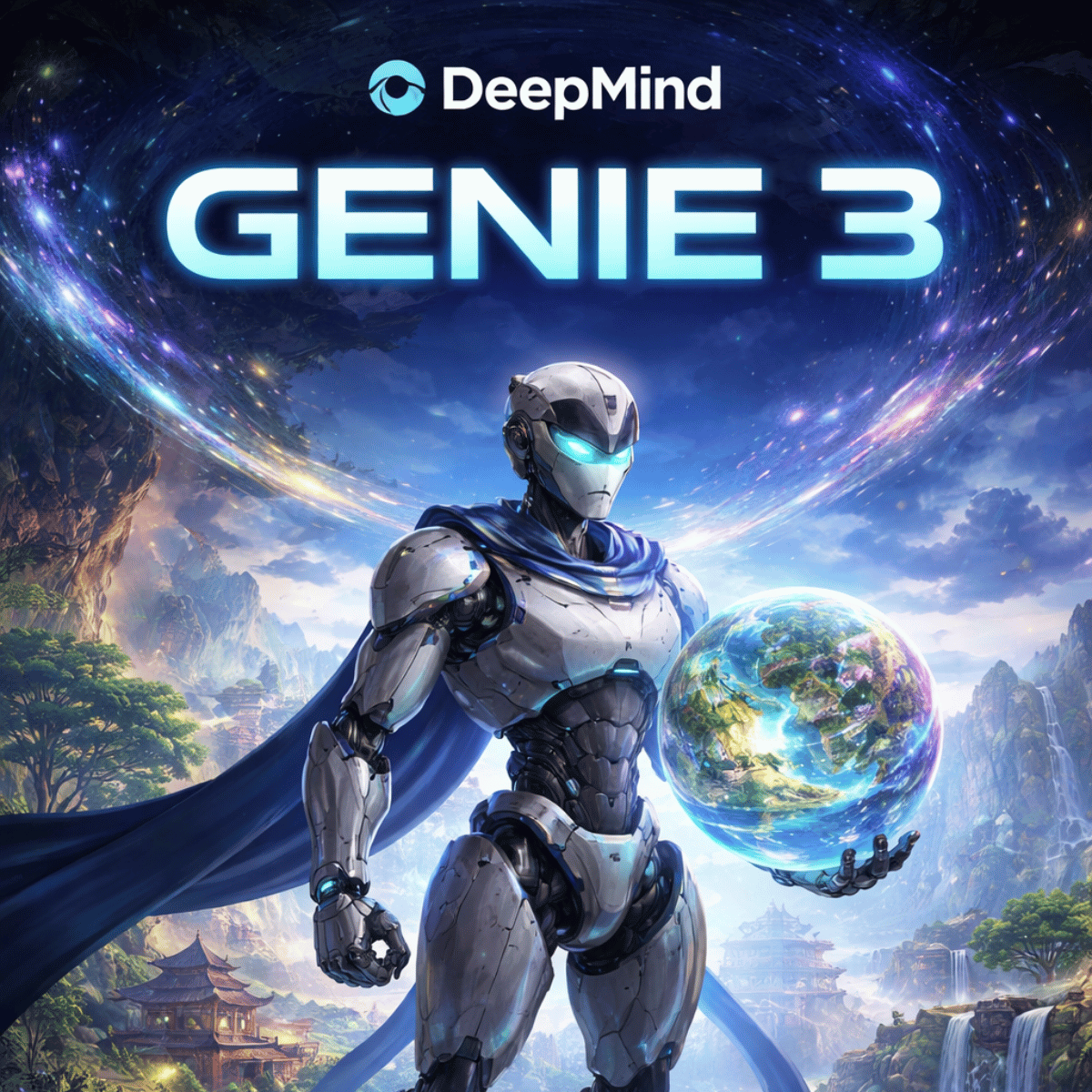
AI generated 3D worlds are fundamentally changing how interactive environments are designed, simulated, and scaled. With advances such as Google DeepMind’s Genie 3, generative AI for game development has moved beyond procedural terrain and scripted logic into data-driven world models capable of predicting and simulating environments in real time. As a result, game studios, XR companies, and immersive experience creators are rethinking traditional pipelines that were once dominated by manual content creation.
However, while AI generated 3D worlds unlock speed and experimentation, they also introduce new layers of engineering complexity. Turning AI-generated environments into stable, performant, and scalable products still requires expert execution across Game AI Development, XR Development, Multiplayer Game Development, PC & Mobile Game Development, and 3D Content & Interactive Solutions, the core services delivered by Uverse Digital.
What Are AI Generated 3D Worlds?
At their core, AI generated 3D worlds are interactive environments created using machine-learning models that learn spatial structure, environmental behavior, and interaction logic from data rather than relying exclusively on handcrafted assets or deterministic procedural rules.
Traditionally, 3D worlds are built through a combination of:
- Level designers manually authoring geometry and layouts
- Environment artists creating static assets and textures
- Procedural systems applying predefined rules for variation
- Pre-baked lighting, physics, and navigation meshes
By contrast, AI generated 3D worlds rely on predictive systems that infer how environments should look and behave at runtime.
AI World Models Explained
AI world models encode environments into latent representations,compact mathematical descriptions of spatial relationships and behaviors. Instead of storing a world as fixed geometry, the model stores knowledge of how the world functions.
Technically, these models:
- Learn spatial continuity and depth from large datasets
- Predict environmental changes frame-by-frame
- Respond dynamically to player movement and input
As a result, AI-generated game environments can evolve organically, allowing for emergent traversal paths, adaptive layouts, and dynamic interaction patterns.
AI World Generation vs Procedural Generation
Although often confused, AI world generation differs significantly from traditional procedural systems.
Procedural generation:
- Uses explicit rules and parameters
- Produces deterministic outputs
- Requires manual tuning to achieve variation
AI generated worlds:
- Operate probabilistically
- Learn patterns instead of following fixed rules
- Adapt to player behavior in real time
Therefore, while AI expands creative possibilities, it also introduces unpredictability that must be carefully engineered.
Key Takeaways
As a result ,AI generated 3D worlds replace rigid rule-based systems with predictive simulation, increasing flexibility while raising technical demands.
Google Genie 3 and the Rise of Generative AI for Game Development
Google DeepMind’s Genie 3 represents a pivotal research milestone in the evolution of AI generated 3D worlds. Unlike traditional game engines or procedural generation tools, Genie 3 operates as a world model, a generative AI system capable of predicting and rendering explorable environments frame by frame based solely on player input and historical context.
Importantly, Genie 3 is not a game engine, nor is it designed to replace existing production pipelines. Instead, it serves as a technical proof-of-concept demonstrating how generative AI for game development could fundamentally change how virtual worlds are created, explored, and iterated.
From a systems perspective, Genie 3 challenges long-standing assumptions about level design, environment authoring, and simulation logic by shifting world creation from explicit rules to learned representations.
What Genie 3 Demonstrates Technically
At its core, Genie 3 illustrates how large-scale generative models can function as continuous world simulators rather than static content generators. This distinction is critical for understanding its technical implications.
Continuous Frame-to-Frame World Prediction
Traditional game engines rely on:
- Authored geometry
- Fixed assets
- Predefined scene graphs
- Deterministic update loops
By contrast, Genie 3 generates each frame as a prediction of what the world should look like next, conditioned on:
- Previous visual frames
- Player input vectors
- Learned spatial and temporal patterns
In contrast to fixed-level pipelines, instead of loading a level, the system infers the environment dynamically, meaning there is no fixed map stored in memory. Every rendered moment is the result of probabilistic inference
As a result, the world appears coherent over short time horizons, even though it is not explicitly stored or simulated in the traditional sense.
Implicit Physics and Collision Inference
One of the most technically striking aspects of Genie 3 is its ability to approximate physics behavior without explicit physics simulation.
Rather than relying on:
- Rigid body solvers
- Collision meshes
- Constraint systems
The model implicitly learns:
- Surface continuity
- Object solidity
- Approximate collision responses
- Environmental affordances
For example, walls remain solid, ground remains walkable, and forward motion produces spatial continuity, all without authored collision data.
However, this behavior emerges statistically, not deterministically.
Therefore, while Genie 3 appears physically plausible, it does not guarantee:
- Stable collision resolution
- Consistent object permanence
- Reproducible physics outcomes
This distinction becomes critical when evaluating production readiness.
Player-Driven Exploration Without Navigation Meshes
In conventional game development, player movement depends on:
- Navigation meshes
- Traversable zones
- Level bounds
- Manually authored constraints
Consequently, Genie 3 removes these constructs entirely.
The player’s movement is interpreted as an input signal, and the AI model predicts how the environment should respond visually. There is no “correct” path, no authored traversal logic, and no baked world structure.
Consequently, exploration becomes emergent rather than designed.
While this unlocks new forms of creativity and rapid ideation, it also introduces major challenges for:
- Gameplay consistency
- Objective-driven design
- AI agent navigation
- Multiplayer synchronization
Technical Capabilities
In summary, Genie 3 demonstrates that AI generated 3D worlds can:
- Predict spatial continuity without stored geometry
- Approximate physics behavior without simulation
- Enable free-form exploration without navigation data
However, these capabilities exist within a research context, not a production framework.
Why Genie 3 Matters for Game Studios and XR Teams
For game studios, XR developers, and immersive simulation teams, Genie 3 is not valuable as a tool, but as a signal.
It points toward a future where AI assists not only with assets, but with world logic itself.
Faster Experimentation in Early Development
During pre-production, teams often struggle with:
- Long level grayboxing cycles
- High iteration costs
- Dependency on environment art
- Delayed gameplay validation
AI world models like Genie 3 suggest a future where:
- Designers can explore spatial ideas instantly
- Engineers can test mechanics without authored levels
- Creative direction can be validated earlier
As a result, AI generated 3D worlds could dramatically compress early-stage development timelines.
This aligns closely with how Uverse Digital approaches Game Development and Game AI Development, where rapid prototyping and technical validation are essential before scaling production.
AI-Assisted World Ideation and Prototyping
Rather than replacing level designers, Genie-style systems act as ideation accelerators.
They can:
- Generate unexpected spatial layouts
- Reveal emergent traversal patterns
- Inspire new gameplay mechanics
- Support experimental world concepts
For XR and simulation teams, this has additional implications:
- Rapid virtual environment sketching
- Scenario-based training simulations
- Exploratory user experience testing
This is particularly relevant to XR Development at Uverse Digital, where immersive environments must balance realism, performance, and user comfort.
New Approaches to Simulation-Based Testing
AI world models also introduce new possibilities for:
- Automated environment testing
- Edge-case exploration
- Stress-testing traversal logic
- Validating player affordances
Because the environment is generated dynamically, it can expose:
- Unexpected spatial configurations
- Non-obvious interaction patterns
- Rare edge cases difficult to author manually
However, this benefit only materializes when AI systems are carefully constrained and monitored, something research demos do not address.
Studio Impact
In short, Genie 3 matters because it:
- Accelerates early-stage experimentation
- Enhances creative ideation
- Enables new testing methodologies
Yet, it does not remove the need for disciplined engineering.
Why Genie-Style Systems Cannot Be Used Directly in Production
Despite its promise, Genie 3 highlights why AI generated 3D worlds cannot currently replace production pipelines.
Lack of Deterministic Behavior
Modern games and XR systems rely on determinism for:
- Bug reproduction
- Multiplayer synchronization
- Replay systems
- State recovery
AI world models generate probabilistic outputs, meaning:
- The same input may not yield the same result
- World states cannot be reliably reproduced
- Debugging becomes significantly harder
In short, This alone makes direct deployment infeasible for live products.
Performance and Memory Unpredictability
Real-time applications require:
- Stable frame times
- Predictable memory usage
- Controlled GPU workloads
Therefore, Generative models, especially large world models, introduce:
- Variable inference costs
- Latency spikes
- Hardware dependency risks
Without tight engineering control, these systems can easily violate performance budgets, especially in VR and multiplayer contexts.
Absence of Multiplayer and Live-Ops Readiness
Production games demand:
- Authoritative server states
- Consistent world replication
- Anti-cheat mechanisms
- Live content updates
Genie-style systems currently lack:
- Network determinism
- State compression strategies
- Server-authoritative logic
- Live content governance
Therefore, integrating them requires expert Game AI Development, not off-the-shelf deployment.
Production Limitations
To summarize, uncontrolled AI world generation can:
- Break gameplay logic
- Produce inconsistent world states
- Introduce performance instability
- Compromise multiplayer integrity
Why AI World Models Must Be Engineered as Subsystems
Most importantly, The key takeaway for studios is this:
AI should augment game engines,not replace them.
At Uverse Digital, AI is treated as a constrained subsystem that integrates with:
- Traditional engines
- Deterministic gameplay logic
- Performance budgets
- Multiplayer architectures
Through Game AI Development, Game Development, and XR Development, AI systems are:
- Bounded by rules
- Monitored for stability
- Integrated with authored content
- Optimized for real-world deployment
This approach ensures that innovation does not come at the cost of reliability.
Final Takeaway
Genie 3 proves that AI generated 3D worlds are technically possible.
However, turning that possibility into a playable, scalable product requires:
- Expert system design
- Disciplined engineering
- Production-aware AI integration
Resultantly, This is where experienced studios, not research demos, define the future of game development.
How AI Generated 3D Worlds Reshape Game Development Pipelines
AI generated 3D worlds do not replace traditional pipelines, they reshape them.
Impact on World Design and Iteration
Additionally, AI world generation enables:
- Rapid exploration of gameplay ideas
- Reduced reliance on placeholder assets
- Faster early-stage iteration cycles
Nevertheless, AI-generated content still requires:
- Manual validation by designers
- Gameplay balance adjustments
- Optimization for target hardware
This is where PC & Mobile Game Development expertise ensures AI-driven environments meet production standards.
Architectural and Performance Implications
Integrating AI generated 3D worlds introduces new system requirements:
- AI inference pipelines sharing GPU/CPU resources
- Memory management for transient world states
- Fallback logic for invalid predictions
Without proper architecture, AI systems can degrade performance and complicate debugging.
Section Summary
AI accelerates iteration, but robust architecture remains essential for production stability.
AI Generated 3D Worlds in Multiplayer Game Development
Multiplayer systems significantly amplify the challenges of AI world generation.
Determinism and Synchronization Challenges
Multiplayer games require:
- Identical world states across clients
- Server-authoritative validation
- Predictable state replication
AI world models are inherently probabilistic, which conflicts with deterministic multiplayer architectures.
Uverse Digital’s Multiplayer Game Development services address this by:
- Centralizing AI inference on authoritative servers
- Restricting AI variability within deterministic bounds
- Synchronizing AI-generated states efficiently
Live Operations and Scalability
Live multiplayer environments demand:
- Stable performance under concurrent load
- Controlled randomness for fairness
- Repeatable gameplay sessions
Without constraints, AI variability can destabilize live services.
Multiplayer games demand control,AI must be engineered for consistency and scalability.
AI Generated 3D Worlds in XR Development
XR applications impose stricter constraints than traditional games.
Performance, Comfort, and Spatial Consistency
XR systems require:
- Stable frame rates to avoid motion sickness
- Predictable spatial logic
- Controlled environmental behavior
Unconstrained AI variability can break immersion and reduce usability.
Uverse Digital’s XR Development services integrate AI world generation within tightly controlled parameters to ensure comfort and performance.
Where AI Adds Real Value in XR
AI generated 3D worlds are especially effective for:
- Adaptive training simulations
- Scenario-based learning environments
- Dynamic immersive storytelling
AI enhances XR realism when guided by expert UX and performance engineering.
Why AI Generated 3D Worlds Still Require Expert Teams
Despite rapid progress, AI cannot independently deliver production-ready experiences.
Limitations of AI-Generated Systems
AI systems struggle with:
- Long-term design coherence
- Player experience balancing
- Cross-platform optimization
- Quality assurance and edge-case handling
This is why 3D Content & Interactive Solutions remain critical for refining AI-generated outputs.
How Uverse Digital Applies AI in Production
Uverse Digital integrates AI through:
- Custom Game AI Development pipelines
- Optimized XR Development workflows
- Scalable Multiplayer Game Development architectures
- Robust PC & Mobile Game Development systems
AI is a force multiplier, expert teams transform AI output into real products.
The Long-Term Future of AI Generated 3D Worlds
Looking ahead, AI generated 3D worlds will evolve into hybrid pipelines that combine:
- Traditional engines
- Procedural systems
- AI-driven simulation layers
Studios that adopt this balanced approach will gain faster iteration, deeper immersion, and long-term scalability.
Conclusion
AI generated 3D worlds represent a major evolution in interactive environment creation. However, they introduce new technical responsibilities rather than eliminating existing ones. Success depends on how intelligently AI systems are constrained, optimized, and integrated.
Uverse Digital enables studios to adopt AI responsibly through expert-led Game AI Development, XR Development, Multiplayer Game Development, PC & Mobile Game Development, and 3D Content & Interactive Solutions.
Book a Free Consultation with Uverse Digital Today , Explore how our expert Game AI Development, XR Development, Multiplayer Game Development, PC & Mobile Game Development, and 3D Content & Interactive Solutions can help you turn AI-generated 3D worlds into scalable, production-ready experiences.”
FAQs: AI Generated 3D Worlds
What are AI generated 3D worlds?
AI generated 3D worlds are interactive environments created using machine-learning models that predict spatial structure and behavior dynamically rather than relying entirely on handcrafted assets or deterministic rules.
How is AI world generation different from procedural generation?
Procedural generation follows predefined rules, while AI world generation learns patterns from data and adapts environments in real time.
Is Google Genie 3 a game engine?
No. Genie 3 is a research demonstration that showcases AI world model capabilities, not a production-ready game engine.
Can AI generated 3D worlds be used in multiplayer games?
Yes, but only when engineered carefully. Multiplayer environments require determinism and server authority, which must be enforced through expert Multiplayer Game Development.
How does AI impact XR development?
AI enables adaptive XR environments, but performance and comfort constraints require controlled integration through professional XR Development.
Will AI replace game developers?
No. AI augments development but still requires expert teams for system design, optimization, UX, and scalability.
About the author : Uverse Digital


Stay Ahead of the Game
Get XR insights, dev tips, and industry updates straight to your inbox
Join our insider list for cutting-edge content on game development, performance optimization, and immersive experiences, curated for industry leaders like you.
