
Introduction
Spatial computing for business has moved out of the demo room and into real UK workplaces. Retailers are cutting return rates with 3D product visualisation, manufacturers are running digital twins on the factory floor, and healthcare teams are training on Apple Vision Pro instead of paper manuals. What used to be a niche R&D experiment is now a genuine operational tool, and the companies moving early are already seeing measurable returns.
This shift matters for any UK business weighing up whether spatial computing is worth the investment in 2026. Below, we look at what spatial computing for business actually means, why UK adoption is accelerating now, where it delivers the clearest return on investment, and what to plan for before you commit budget to a pilot.
We will also cover the platform decisions, compliance questions, and partner considerations that separate a successful spatial computing rollout from a stalled pilot. By the end, you should have a clear, practical view of whether spatial computing fits your roadmap this year, and what a sensible first step looks like.
| What Is Spatial Computing for Business?
• Spatial computing for business uses devices like Apple Vision Pro, AR headsets, and 3D sensors to blend digital content with the physical workplace. • It supports use cases including training, product visualisation, digital twins, and remote collaboration. • UK adoption is growing fastest in retail, healthcare, manufacturing, and enterprise training. |
What Is Spatial Computing for Business?
At its core, spatial computing for business refers to technology that lets digital content exist naturally alongside the physical world, rather than being trapped behind a flat screen. Instead of opening an app on a laptop, an employee might see a 3D model floating on their workbench, or a trainee might practise a procedure on a life-size virtual patient. The technology reads the room, tracks hands and eyes, and places information exactly where it is useful.
How It Differs from Traditional AR and VR
Spatial computing is broader than either AR or VR alone. Virtual reality fully replaces the user’s surroundings, while augmented reality overlays simple graphics on a camera feed. Spatial computing sits above both, combining real-time environmental mapping, hand and eye tracking, and persistent digital objects that behave as if they belong in the room. This is what allows a business to run a virtual meeting, a training simulation, and a product walkthrough on the same platform.
The Core Technologies Behind It
Most enterprise spatial computing projects today are built on one of two ecosystems. Apple’s visionOS, used by Apple Vision Pro, is built around RealityKit, SwiftUI, and ARKit and is currently the strongest option for polished, business-ready spatial apps. OpenXR, the open standard backed by Khronos, covers headsets such as Meta Quest and HoloLens-class devices. The two platforms do not share full API compatibility, which is an important planning point covered later in this article.
Inside-out tracking is what makes modern spatial devices practical for a real office or factory floor. Earlier headsets relied on external cameras or base stations, which meant a fixed, calibrated space. Today’s devices sense the environment directly through onboard cameras, building a live 3D map as the wearer moves, so there is no room-scale setup and no calibration ritual before every use.
Why UK Businesses Are Investing in Spatial Computing Now
Interest in spatial computing for business has grown sharply since Apple Vision Pro launched enterprise-focused tools, and the UK is one of the more active European markets. Government-backed investment in digital transformation, combined with a robust industrial base, is pushing adoption across sectors including manufacturing, healthcare, and financial services.
Enterprise Adoption Trends
Enterprise use of spatial computing is now outpacing consumer adoption. Surgical teams, manufacturing lines, and research labs are running production deployments, not just pilots. That enterprise-first pattern is expected to continue through 2026 as headset prices stabilise and business-specific software matures.
Interestingly, the wider market data backs this up. Overall headset volumes actually fell in the past year, while displayless smart glasses grew sharply, a sign that the market is shifting towards lighter, task-focused devices rather than bulkier consumer headsets. For UK businesses, that trend points towards spatial tools becoming a normal part of the working day, worn briefly for a specific task rather than a novelty for special occasions.
The Apple Vision Pro Effect
Apple Vision Pro changed the conversation for many UK decision-makers because it was positioned from day one as a productivity device, not a gaming headset. It integrates directly with everyday business tools, supports large-scale data visualisation, and gives teams an expanded, private workspace without needing multiple monitors.
Business Apps Already Live on visionOS
Teams are already using Vision Pro alongside familiar collaboration and productivity tools, and pairing it with platforms built for data-heavy analysis and 3D visualisation. Developers can also bring existing business apps across to visionOS or build spatial-native tools from the ground up using the visionOS SDK.
Real-World Business Use Cases
Spatial computing is no longer confined to a single sector. Four industries in particular are showing the clearest, most repeatable results in the UK.
Retail: 3D Product Visualisation
Retailers using AR-assisted product visualisation are seeing return rates fall by 22 to 35 percent, alongside conversion rate increases as high as 40 to 94 percent in controlled experiments. Customers can view furniture, fittings, or equipment at true scale in their own space before buying, which cuts down on costly returns and mismatched expectations.
Healthcare: Training and Visualisation
Healthcare has become one of the strongest proof points for spatial computing, with surgical teams using Vision Pro for procedure visualisation and hospitals piloting spatial tools fo r patient education. Training environments let clinicians repeat high-risk procedures safely, improving confidence and precision before real-world application.
Medical imaging is another area where spatial computing adds something a flat screen cannot. A CT or MRI scan viewed as a floating 3D model, rather than a stack of 2D slices, gives clinicians a more intuitive sense of scale and spatial relationships before a procedure, which is particularly valuable in complex or unusual cases.
Manufacturing: Digital Twins and Remote Assistance
UK manufacturers are following the lead of programmes in Germany and the US, using mixed-reality workstations and digital twins to plan layouts, guide assembly, and support remote maintenance. This reduces travel costs for specialist engineer s and shortens the time it takes to diagnose faults on the factory floor.
A digital twin also gives operations teams a live, explorable model of a production line, letting them test a layout change or spot a bottleneck virtually before committing to a costly physical changeover.
Enterprise Collaboration and Productivity
Spatial computing also supports everyday enterprise work. Distributed teams can meet in a shared spatial workspace, review 3D data models together, and manage information across multiple virtual screens without extra hardware. For UK businesses managing hybrid teams, that flexibility is a practical, near-term benefit rather than a future promise.
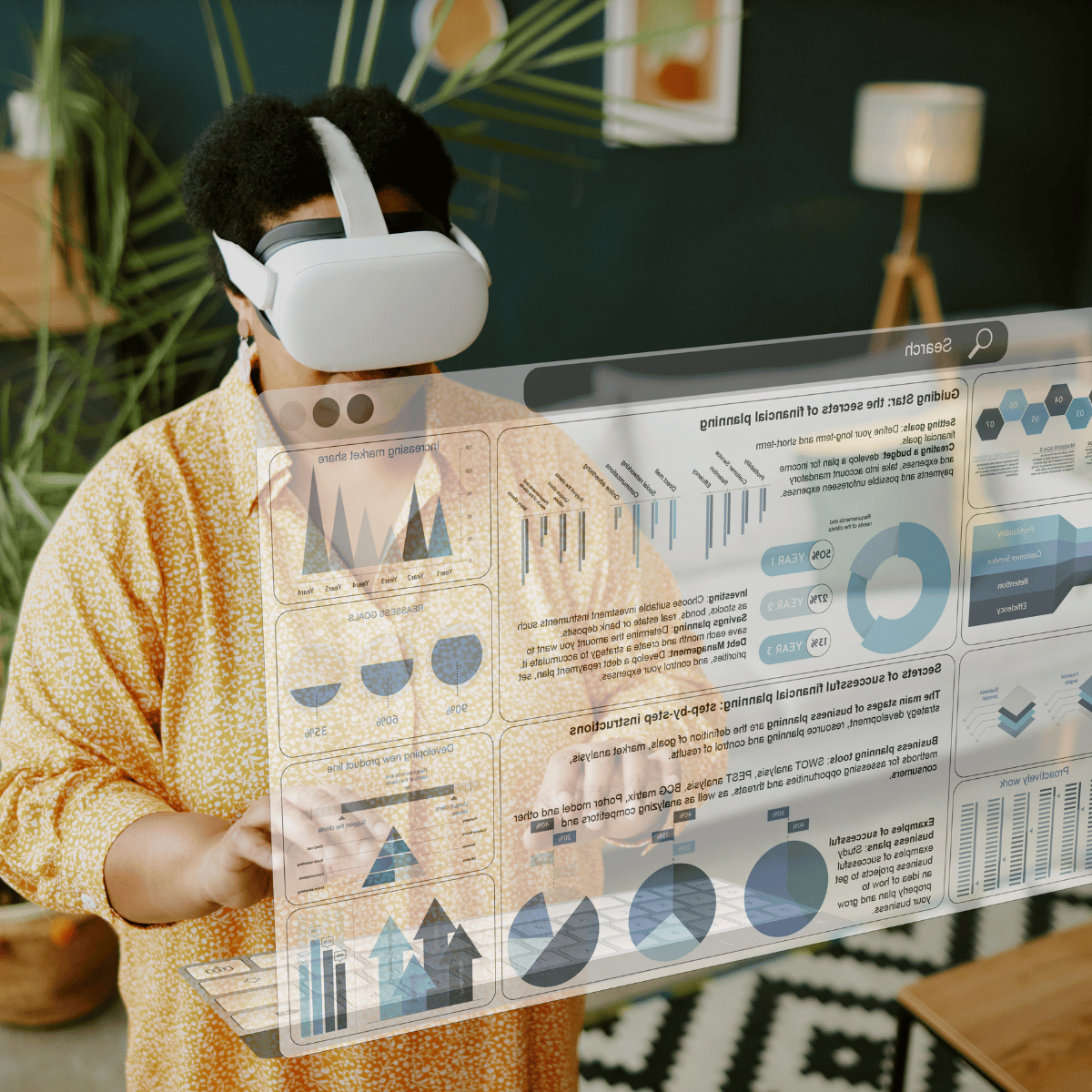
Financial and data-heavy teams are also finding value here. Reviewing a large dataset or a complex model across several virtual screens, arranged exactly as needed, can replace a physical multi-monitor setup entirely, which is a genuinely useful benefit for hybrid and remote-first teams.
The ROI Case for Spatial Computing
Spending on any new platform needs a clear business case, and spatial computing is increasingly able to provide one. The strongest returns are showing up in two areas: reduced errors and faster, more effective training.
Cost and Error Reduction
Retail return-rate reductions and manufacturing error reductions both translate directly into recovered margin. Because spatial tools let people check and rehearse before committing, from a customer confirming a product fit to an engineer walking through an assembly sequence, businesses catch costly mistakes earlier.
Training and Onboarding Efficiency
Repeatable, risk-free simulation is one of the clearest wins. Staff can practise procedures as many times as needed without using physical stock, specialist equipment, or clinical time, which shortens onboarding and improves retention compared with traditional 2D instructional materials.
| Snapshot: Spatial Computing ROI Signals
• 22 to 35 percent reduction in retail returns using AR-assisted product visualisation. • 40 to 94 percent conversion rate uplift in controlled retail experiments. • Faster, safer training cycles reported across healthcare and manufacturing pilots. • Reduced travel and downtime through remote, spatial-guided maintenance. |
Challenges to Plan For
Spatial computing offers real advantages, but it is not a drop-in replacement for existing systems. Three challenges consistently come up in early planning conversations.
Platform Fragmentation: visionOS vs OpenXR
Apple’s visionOS and the open OpenXR standard do not share API compatibility, and Apple is not an OpenXR participant. Businesses building for both Apple Vision Pro and Quest-class or HoloLens-class devices need a development partner who can plan for that split from the outset, rather than porting a single build across platforms after the fact.
This matters most for organisations issuing devices to a mixed workforce, where some staff may use Vision Pro and others a lower-cost OpenXR headset. Deciding early whether to build twice, or to prioritise one platform for launch and add the other later, avoids expensive rework further into the project.
Data Privacy and Compliance
Spatial devices capture detailed information about a physical environment, which raises data protection questions that go beyond a typical app deployment. Businesses working in regulated sectors such as healthcare or financial services need to build compliance into the project from day one, not bolt it on afterwards.
This includes being clear about what spatial and environmental data is stored, for how long, and who can access it, particularly where a headset is used in a space shared with colleagues, patients, or customers.
Content Development Costs
Custom spatial apps and 3D environments require specialist design and engineering skills that differ from conventional mobile or web development. Businesses should budget for spatial-specific UX design, 3D asset creation, and on-device testing as distinct line items rather than assuming existing app budgets will stretch to cover them.
How to Get Started with Spatial Computing for Your Business
Businesses that get the most value from spatial computing tend to start small, prove the concept, and scale deliberately.
Choosing a Development Partner
Look for a partner with genuine spatial UX experience rather than a mobile app team adapting flat-screen patterns. Ask about shipped XR work, fluency across both visionOS and OpenXR-based platforms, and a process built around testing on real hardware rather than simulators alone.
It is also worth asking how a prospective partner handles the handover between design and engineering. Spatial interfaces depend on depth, scale, and hand tracking in ways a traditional wireframe cannot capture, so a partner who prototypes directly on-device, rather than relying solely on flat mockups, is far more likely to catch usability issues before launch.
A Pilot-First Approach
A focused proof-of-concept, built around one clear business use case, is the lowest-risk way to test spatial computing before wider rollout. This lets a business validate the return on investment, gather user feedback, and refine the approach before committing to a full production build.
How Uverse Digital Supports Spatial Computing Projects
Uverse Digital’s Spatial Computing Development service covers the full journey from concept to launch, including Apple Vision Pro applications, 3D product visualisation, immersive training builds, and AR and MR experiences designed around your business goals.
This sits alongside Uverse Digital’s wider VR/MR/AR Development service and complements the practical training use cases explored in our earlier look at XR Training Simulations for enterprise learning and development. Whether you need a focused proof-of-concept or a full spatial application, our team handles design, 3D development, interaction, testing, and deployment as one connected process.
Ready to Explore Spatial Computing for Your Business?
Spatial computing for business is no longer experimental. From retail visualisation to manufacturing digital twins, UK companies are already proving the return on investment. Get in touch with Uverse Digital to discuss where a spatial computing pilot could fit into your business.
FAQs: Spatial Computing for Business
What is spatial computing used for in business?
Businesses use spatial computing for product visualisation, staff training, digital twins, remote assistance, and spatial collaboration between distributed teams.
Is Apple Vision Pro suitable for enterprise use?
Yes. Apple has positioned Vision Pro specifically for enterprise use, with support for business productivity tools, data visualisation platforms, and custom visionOS apps built with RealityKit and SwiftUI.
How much does a spatial computing project cost?
Costs vary with scope. A simple proof-of-concept typically takes a matter of weeks, while a full custom spatial application with multi-user features can take several months. A development partner should provide a detailed timeline and cost estimate before work begins.
Do we need separate builds for Apple Vision Pro and other headsets?
In most cases, yes. Because visionOS and OpenXR do not share full API compatibility, businesses targeting both Apple Vision Pro and other headsets should plan for platform-specific development from the start.
What industries benefit most from spatial computing?
Retail, healthcare, manufacturing, and enterprise training currently show the clearest, most measurable returns, though collaboration and productivity use cases are growing across most sectors.
About the author : Uverse Digital

Uverse Digital helps businesses build high-performance games, XR experiences, mobile and web apps. Creating scalable digital solutions that deliver real business value, with reliable white-label development for agencies.
- Introduction
- What Is Spatial Computing for Business?
- Why UK Businesses Are Investing in Spatial Computing Now
- Real-World Business Use Cases
- The ROI Case for Spatial Computing
- Challenges to Plan For
- How to Get Started with Spatial Computing for Your Business
- How Uverse Digital Supports Spatial Computing Projects
- Ready to Explore Spatial Computing for Your Business?
- FAQs: Spatial Computing for Business
Have a Project in Mind?
Let’s turn your idea into a high-quality game, XR experience, or app.



Stay Ahead of the Game
Get XR insights, dev tips, and industry updates straight to your inbox
Join our insider list for cutting-edge content on game development, performance optimization, and immersive experiences, curated for industry leaders like you.