
Introduction
The UK reality gaming market is entering a defining phase in 2026, where immersive technologies are no longer experimental concepts but foundational pillars of modern game development. Built on virtual reality (VR), augmented reality (AR), and mixed reality (MR), collectively known as XR, this market is fundamentally changing how players interact with digital worlds.
Unlike traditional gaming environments, where interaction is limited to screens and controllers, reality gaming places users inside the experience itself. This shift is not just visual, it is behavioral, emotional, and technological.
In the UK, this transformation is accelerating faster than many global regions due to a combination of strong gaming culture, technological innovation, and increasing investment in immersive technologies. However, despite this momentum, many game studios still struggle to transition from traditional development pipelines to XR-first design thinking.
The result is a growing gap between demand and delivery capability. On one side, players expect highly immersive, real-time, interactive experiences. On the other, studios are still adapting to the complexity of building scalable XR systems that perform reliably across devices.
This tension is exactly what defines the UK reality gaming market today.
What is the UK Reality Gaming Market?
The UK reality gaming market refers to the ecosystem of immersive gaming experiences developed using VR, AR, and MR technologies, collectively known as XR. It includes entertainment gaming, location-based immersive experiences, and enterprise applications such as simulation-based training, education systems, and interactive digital environments that blend physical and virtual worlds.
Evolution of Reality Gaming in the UK
The evolution of the UK reality gaming market represents one of the most significant shifts in modern interactive entertainment, as gaming moves from screen-based interaction to fully immersive digital experiences.
For decades, gaming followed a static interaction model, where players engaged through controllers, keyboards, and screens. While this model produced globally successful franchises, it also created clear limitations in immersion, physical engagement, and realism.
From Traditional Gaming to Immersive XR Systems
With the arrival of XR technologies, this structure began to change rapidly. The transformation can be understood through three major breakthroughs:
- Virtual Reality (VR): Introduced full immersion by placing players inside fully digital environments
- Augmented Reality (AR): Added digital layers on top of the real world, enhancing physical surroundings
- Mixed Reality (MR): Combined both physical and digital worlds into interactive, responsive ecosystems
As a result, gaming shifted from being “played on a device” to being “experienced within a world.”
Technological Advancements Driving the Shift
This evolution has not happened in isolation. It has been powered by continuous improvements in core technologies such as:
- Advanced motion tracking systems that improve physical interaction accuracy
- High-performance spatial audio that enhances environmental realism
- Real-time rendering engines that support complex immersive worlds without latency
- Mature development platforms like Unity and Unreal Engine enabling scalable XR production
At the same time, cloud computing and edge processing have made it possible to deliver more stable, high-performance immersive experiences across devices.
Why the UK is a Key XR Gaming Hub
In the UK, this evolution has accelerated faster than many other regions due to a unique combination of ecosystem strengths:
- A strong and historically established gaming industry base
- Leading universities and research institutions focused on immersive technologies
- Increasing venture capital investment in XR startups and gaming studios
- Rapid adoption of interactive entertainment and simulation-based applications
Consequently, the UK has positioned itself as one of the leading innovation hubs for XR gaming in Europe.
Shift in Game Design Philosophy
Beyond technology, the evolution has also changed how games are designed. Modern XR development now focuses on:
- Presence-based experiences instead of screen-based interaction
- Real-time responsiveness instead of pre-scripted gameplay
- Physical movement integration instead of static input systems
- Adaptive environments that respond dynamically to user behavior
This shift is redefining not just how games look, but how they feel and behave.
Key Insight
Overall, the evolution of reality gaming in the UK is not just a technological upgrade, it is a complete redesign of interactive entertainment architecture, where immersion, intelligence, and interactivity merge into a unified experience.
Why the UK Reality Gaming Market is Expanding Rapidly
The expansion of the UK reality gaming market is not driven by a single trend, but by a powerful convergence of technological acceleration, shifting user behavior, and expanding commercial applications. Together, these forces are reshaping the gaming industry into a more immersive, real-time, and experience-driven ecosystem.
Rising Expectations from Modern Players
One of the strongest drivers is the evolution of player expectations. Today’s users no longer engage with games passively, they expect responsive, intelligent, and immersive environments that react to their decisions in real time.
As a result:
- Static gameplay models are becoming outdated
- Real-time interaction is becoming the baseline expectation
- Immersion is now a key measure of game quality
This shift is forcing studios to rethink traditional development approaches and move toward XR-first design systems.
Rapid Democratization of XR Hardware
Another major acceleration factor is the increasing accessibility of XR devices. What was once limited to high-budget studios and niche audiences is now becoming mainstream.
Key changes include:
- Lower-cost VR headsets entering consumer markets
- Improved processing power in mobile and standalone devices
- Wider availability of AR-capable smartphones
Consequently, the potential user base for reality gaming has expanded significantly, making XR development more commercially viable than ever before.
Strong UK Innovation and Investment Ecosystem
The UK has also created a strong structural foundation for XR growth. Both public and private sectors are actively investing in immersive technologies.
This includes:
- Government-backed innovation and digital transformation programs
- Startup accelerators focused on gaming and immersive tech
- Academic-industry collaborations in XR research and development
- Increasing venture capital funding for XR gaming studios
Together, these factors are reducing entry barriers and accelerating experimentation across the industry.
Expansion Beyond Entertainment Use Cases
Perhaps the most important driver is that XR is no longer limited to gaming. It is rapidly expanding into high-value industries such as:
- Corporate training and simulation environments
- Healthcare visualization and surgical training systems
- Military simulation and strategic planning tools
- Educational and interactive learning platforms
This diversification is critical, because it transforms XR from a niche entertainment segment into a multi-industry technology ecosystem, significantly increasing its long-term market stability and growth potential.
Key Insight
In summary, the rapid expansion of the UK reality gaming market is not speculative, it is structural. It is being driven by user demand, hardware accessibility, institutional investment, and cross-industry adoption, all moving simultaneously.
Core Structure of the UK Reality Gaming Ecosystem
The UK reality gaming ecosystem operates as a layered system where multiple technologies and systems interact to create immersive experiences.
XR Technology Foundation Layer
This layer includes VR, AR, and MR technologies that define how users perceive and interact with digital environments. VR provides full immersion, AR overlays digital elements onto the real world, and MR blends both into hybrid experiences.
Development Infrastructure Layer
This layer includes game engines such as Unity and Unreal Engine, cloud computing platforms, physics engines, and rendering systems. These technologies allow developers to build, simulate, and deploy immersive environments at scale.
Experience and Interaction Layer
This final layer includes gameplay systems, UI/UX design, multiplayer interaction, spatial audio systems, and real-time responsiveness. It defines how users actually experience the game environment.
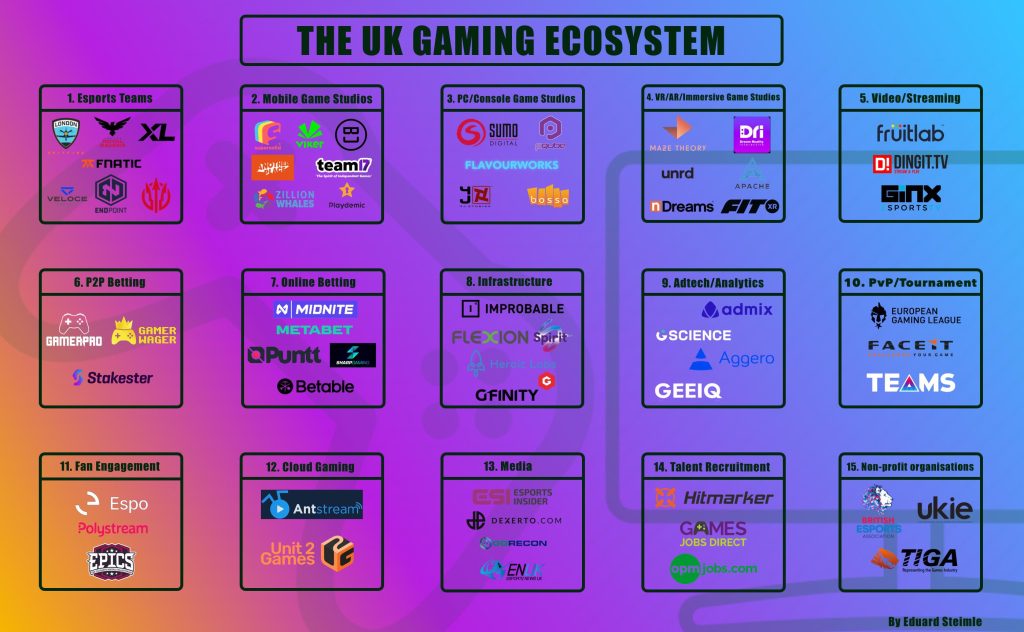
UK Gaming Ecosystem
Benefits of the UK Reality Gaming Market for Game Studios
The UK reality gaming market provides substantial strategic advantages for game studios that are ready to adopt immersive technologies.
Strategic and Commercial Advantages
- Enables significantly higher player engagement through immersive presence-based gameplay
- Unlocks new monetization models such as subscription-based experiences and virtual assets
- Provides strong differentiation in a highly competitive global gaming market
- Expands opportunities into enterprise simulation and training industries
- Increases player retention and session duration through immersive design
- Strengthens studio positioning as innovation leaders in XR development
- Creates scalable opportunities across multiple platforms and devices
These advantages make XR not just a technological upgrade but a fundamental shift in how gaming businesses operate and scale.
Key Trends in the UK Reality Gaming Market in 2026
The UK reality gaming market is being shaped by several transformative trends that are redefining development priorities.
One of the most important trends is the rise of location-based VR gaming. Physical spaces are being transformed into immersive multiplayer environments where users can interact in shared virtual worlds.
Another major trend is the integration of artificial intelligence into immersive systems. AI is being used to create adaptive NPC behavior, dynamic storytelling, and personalized gameplay experiences that evolve in real time.
Cross-platform gaming is also becoming a core expectation. Players now demand seamless experiences across VR headsets, consoles, and mobile devices without losing continuity.
Additionally, XR is expanding rapidly into enterprise applications, including training simulations, product visualization, and remote collaboration systems.
Finally, investment in XR gaming studios across the UK continues to grow, signaling long-term confidence in the market’s potential.
Challenges Facing Game Studios in the UK Reality Gaming Market
Performance Optimization Complexity
XR environments require extremely high frame rates and ultra-low latency. Even small performance issues can break immersion and reduce user engagement significantly.
Multiplayer Synchronization Challenges
Real-time multiplayer XR systems require highly optimized backend architecture to ensure smooth interaction between users in shared environments.
High Development and Production Costs
XR development involves specialized hardware, advanced software tools, and highly skilled developers, making it significantly more expensive than traditional game development.
XR Talent Shortage in the UK Market
There is a growing shortage of experienced XR developers, designers, and engineers capable of building production-ready immersive systems.
Scaling from Prototype to Production
Many XR projects perform well in prototype stages but fail when scaled to real-world usage due to performance and architectural limitations.
How Game Studios Can Succeed in the UK Reality Gaming Market
Success in the UK reality gaming market requires a fundamental shift in development mindset.
Studios must prioritize scalable XR architecture from the earliest stages of development. Optimization must be embedded into system design rather than treated as a final step.
Immersive UX design is also critical, as user interaction in 3D environments must feel natural, intuitive, and responsive.
Cross-platform deployment strategies should be built into the roadmap early to ensure maximum reach across devices.
Most importantly, collaboration with experienced XR development partners helps studios reduce risk and accelerate production timelines.
Why Uverse Digital is the Ideal XR Development Partner
Uverse Digital enables game studios to build scalable, high-performance immersive experiences designed for real-world deployment.
Through XR Development, studios can create fully immersive environments optimized for performance and scalability. Game Development services support end-to-end production from concept to deployment.
UI/UX Design ensures seamless interaction within spatial environments, while AI Development enhances gameplay intelligence and adaptability.
Multiplayer Development enables real-time interaction across users without performance degradation, ensuring smooth and scalable gameplay experiences.
Key Takeaways from the UK Reality Gaming Market
The UK reality gaming market is transitioning from early adoption to mainstream integration. XR technologies are no longer experimental but are becoming central to modern game development strategies.
Studios that invest early in immersive technologies will gain a significant competitive advantage. However, success depends on execution quality, scalability, and technical depth, not just adoption.
The most important insight is that XR gaming is not a future trend, it is already reshaping the present.
Blog Summary
The UK reality gaming market represents one of the most significant transformations in modern gaming. Driven by XR technologies, evolving player expectations, and increasing investment, the market is rapidly moving toward fully immersive, interactive experiences.
However, despite strong demand, many studios face challenges in performance optimization, multiplayer scaling, and XR development complexity. This creates a gap between opportunity and execution capability.
Studios that successfully bridge this gap will define the future of gaming. Those that fail to adapt will struggle to compete in an increasingly immersive digital ecosystem.
Conclusion
The UK reality gaming market is no longer an emerging opportunity, it is a rapidly evolving industry shaping the future of interactive entertainment.
Game studios that adopt XR capabilities today will lead the next generation of immersive gaming experiences. However, success requires more than vision, it requires execution excellence.
To build scalable, high-performance immersive gaming experiences, studios need the right technical partner.
The UK reality gaming market is evolving quickly, and the difference between studios that lead and those that fall behind is execution speed and technical capability.
At Uverse Digital, we help game studios design and build production-ready XR experiences that are optimized for performance, scalability, and real-world deployment.
Take the next step
If you’re exploring an XR game concept or planning to scale an immersive product, we can help you define the right technical roadmap and execution strategy.
Book a meeting with our XR specialists today to discuss your project requirements, and get a custom development quote tailored to your studio’s goals, scope, and timeline.
Frequently Asked Questions
What is the UK reality gaming market?
The UK reality gaming market is the ecosystem of immersive gaming experiences built using virtual reality (VR), augmented reality (AR), and mixed reality (MR). These technologies collectively form XR (extended reality), enabling players to interact with fully or partially digital environments in real time. It includes entertainment gaming, location-based immersive experiences, and enterprise simulation applications used for training, education, and interactive engagement.
Is the UK reality gaming market growing in 2026?
Yes, the UK reality gaming market is growing rapidly in 2026 due to rising demand for immersive gaming experiences, increasing adoption of XR hardware, and strong investment in gaming innovation. Additionally, advancements in AI, cloud computing, and real-time rendering technologies are accelerating the development of scalable immersive environments across the UK.
What technologies are used in reality gaming?
Reality gaming is powered by VR, AR, and MR technologies, which together form XR. These are supported by game engines like Unity and Unreal Engine, along with cloud infrastructure, motion tracking systems, spatial audio, and real-time rendering technologies that enable interactive and immersive 3D environments.
Why is the UK important for the reality gaming market?
The UK plays a major role in the global reality gaming market due to its strong gaming industry ecosystem, skilled talent pool, research institutions, and increasing investment in immersive technologies. Cities like London and Manchester are becoming key hubs for XR innovation and game development.
How can game studios succeed in the UK reality gaming market?
Game studios can succeed by focusing on scalable XR architecture, optimizing performance from early development stages, designing intuitive immersive UX, and planning for cross-platform deployment. Partnering with experienced XR development teams also helps reduce risk and improve production efficiency.
What is the future of the UK reality gaming market?
The future of the UK reality gaming market is driven by AI integration, XR hardware advancements, and the convergence of gaming with enterprise applications. Over time, immersive experiences will become mainstream, creating seamless interactions between physical and digital environments and redefining how games are played and developed.
About the author : Uverse Digital

Uverse Digital helps businesses build high-performance games, XR experiences, mobile and web apps. Creating scalable digital solutions that deliver real business value, with reliable white-label development for agencies.
Have a Project in Mind?
Let’s turn your idea into a high-quality game, XR experience, or app.



Stay Ahead of the Game
Get XR insights, dev tips, and industry updates straight to your inbox
Join our insider list for cutting-edge content on game development, performance optimization, and immersive experiences, curated for industry leaders like you.
